





Author: Ben Barron-Millar, Senior Consultant, Value Communication
A summary of NICE’s disease-specific reference case extension for managing overweight and obesity in adults (PMG50), published 6 May 2026
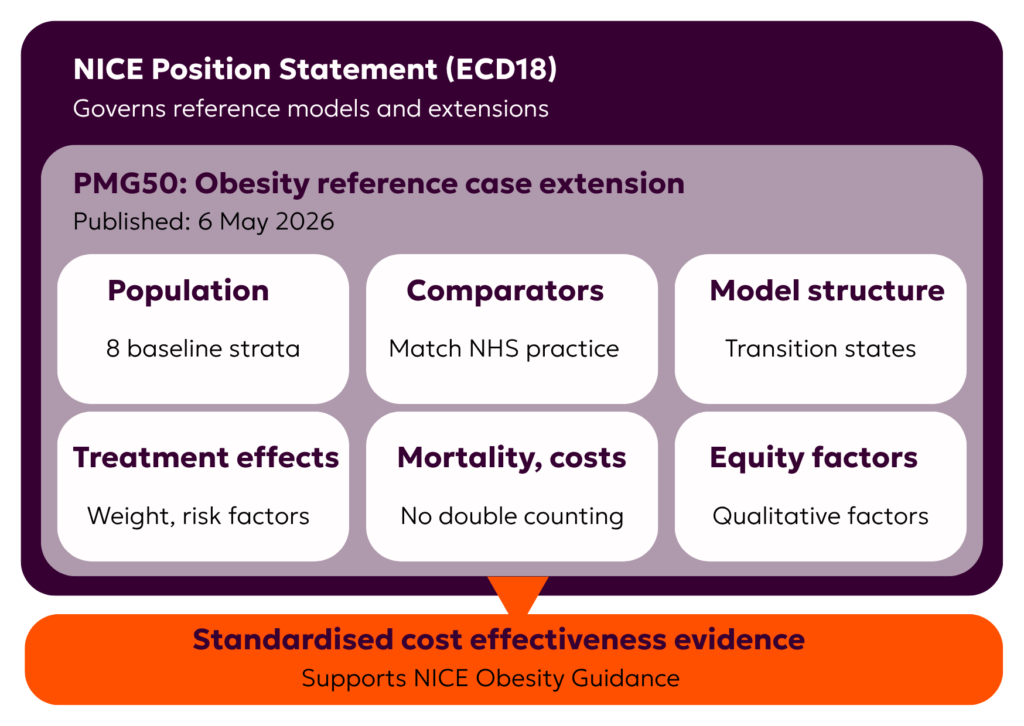
Following on from last year’s National Institute for Health and Care Excellence (NICE) position statement on the use of disease-specific reference models (ECD18)*, NICE’s PMG50 gives obesity health economic modelling a clearer rulebook**. Published on 6 May 2026, the disease-specific reference case extension standardises how submissions should define populations, comparators, health states, treatment effects, long-term assumptions, costs and equity considerations (see summary Figure 1). For modellers, the message is simple: future obesity appraisals need to be more consistent, transparent and comparable.
- Population definitions are now more prescriptive
Analyses must split results across relevant strata based on overweight or obesity, type 2 diabetes and atherosclerotic cardiovascular disease. PMG50 also encourages further subgrouping by body mass index (BMI) class, ethnicity-adjusted BMI thresholds and key comorbidities, using real-world National Health Service (NHS) baseline data wherever possible.
- Comparators must match real NHS practice
Submissions should compare new interventions with what patients actually receive in the NHS, including behavioural support, existing medicines, bariatric surgery and digital tools where relevant. NICE also asks for a minimal-intensity sensitivity scenario based on annual general practitioner (GP) advice on diet and exercise.
- Model structures need to capture the main clinical pathways
NICE prefers state-transition models, either cohort-based or individual patient simulations, with cycles no longer than one year. Required health states include diabetes progression, cardiovascular events, weight category, treatment line and death, with kidney disease and other high-cost events captured where relevant.
- Long-term weight assumptions are central
Where direct comparative trial evidence is limited, treatment effects should be modelled through changes in weight, blood pressure, HbA1c and cholesterol using validated risk equations. Scenario analyses must test weight regain, waning effect and discontinuation, including faster regain after stopping medication.
- Avoid double-counting benefits, risks and costs
Mortality should be modelled using either BMI-adjusted all-cause mortality or condition-specific mortality, not both. Utilities should reflect age, sex, BMI and event-specific decrements, while cost inputs must avoid overlap between weight-related and comorbidity-related sources.
- Equity matters, but mainly as supporting evidence
Because obesity disproportionately affects deprived communities, PMG50 allows distributional cost-effectiveness analysis as supporting evidence. It also highlights qualitative issues that may be hard to model, such as fertility, access to transplant eligibility and the practical burden of bariatric surgery recovery.
In conclusion, PMG50 represents a core shift in economic modelling, moving away from previous broad HTA guidance. For obesity HTA submissions, the use of a disease-specific reference case will likely improve consistency, transparency, and comparability.
However, this comes at a cost of greater evidence-generation requirements and reduced flexibility in economic modelling. By prescribing how populations, comparators, outcomes and long-term assumptions should be handled, NICE is reducing the scope for variation between obesity models. HTA submissions are likely to be impacted with modelling choices that were once defensible on pragmatic grounds may no longer be accepted.
Practically, manufacturers will need to begin evidence generation, modelling strategy, and HTA planning at an earlier stage to enable alignment with NICE’s expectations from the outset.
Clients should consider whether their current evidence package can support PMG50 requirements, particularly around population stratification, comparator selection and long-term weight trajectories. Kintiga can help you to assess readiness, identify evidence gaps, and develop modelling strategies aligned with NICE’s evolving expectations for obesity appraisals. This in turn will enable optimal positioning for smoother HTA discussions and more robust, credible reimbursement dossiers.
Figure 1: Summary schematic of the obesity reference case relative to NICE position statement and cost-effectiveness analysis.
References:
* NICE (2025) EC18: Use of disease-specific reference models in economic evaluations: NICE position statement.
URL: https://www.nice.org.uk/corporate/ecd18; last accessed 09 July 2026.
** NICE (2026) PMG50: Disease-specific reference case extension: management of overweight and obesity in adults.
URL: https://www.nice.org.uk/process/PMG50; last accessed 09 July 2026.