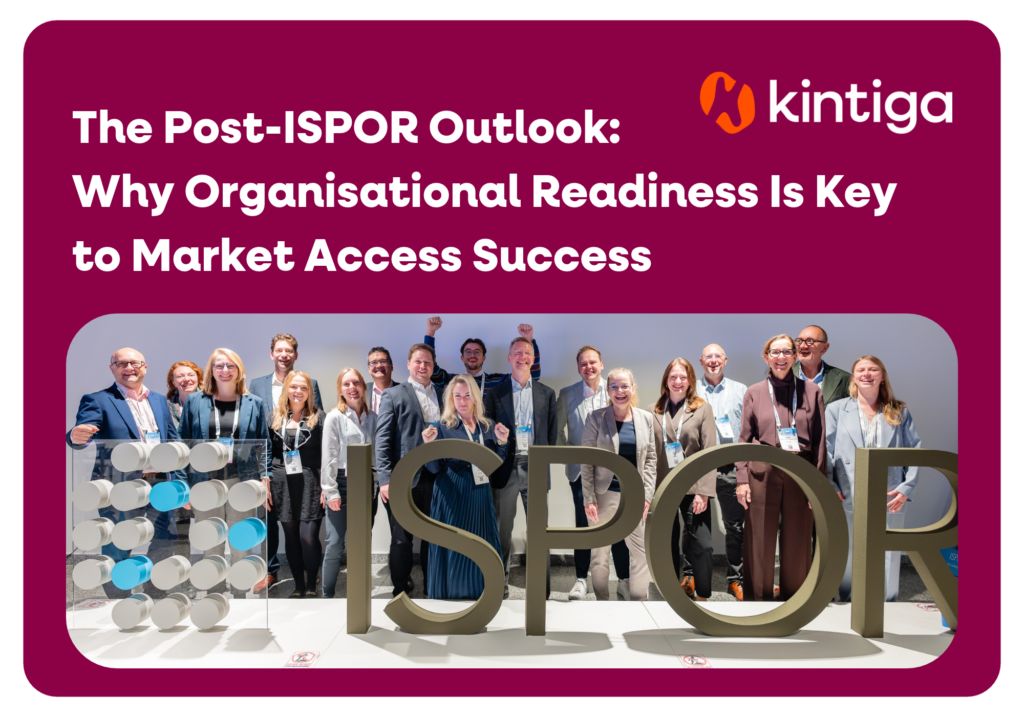






These insights were curated by our team on the ground at ISPOR Europe 2026, including: Univ. Prof. Dr. Matthias Schönermark; Ruth Howells; David Robinson; Dr. rer. nat. Katharina Wolff-Kuhne; Maud Brijs, MSc; Marieke Schurer, MSc; Dr. rer. nat. Tobias Schüning; Sven Büscher; Rory McAtamney & Aoife Fitzpatrick.
ISPOR Europe 2026 reinforced a reality that many pharmaceutical and biotech leaders are already experiencing: the market access environment is becoming increasingly interconnected.
EU HTA implementation, evolving US pricing policy, and the rapid adoption of Artificial Intelligence are often discussed as separate developments. In practice, they are placing similar demands on organisations: earlier planning, stronger cross-functional alignment, and greater confidence in strategic decision-making under uncertainty.
For executives responsible for market access, evidence generation, pricing, and portfolio strategy, the central question is no longer whether these changes matter. It is whether the organisation is prepared to respond effectively.

Joint Clinical Assessments: Early Readiness as a Strategic Imperative
The first Joint Clinical Assessments (JCAs) have moved EU HTA from policy design into operational reality. Early experience has highlighted both the opportunities and challenges associated with the new framework. Much of the discussion at ISPOR focused on orphan medicines and the practical realities of evidence generation. Pharmaceutical companies raised concerns about how therapeutic context, unmet need, and evidence limitations are considered within assessments, particularly for rare diseases. At the same time, HTA bodies and members of the HTA Coordination Group emphasised the importance of methodological consistency and transparency.
Perhaps the most important lesson was practical rather than methodological: decisions made early in development can have significant consequences later in the process. Conference discussions highlighted that changes to the intended EMA indication can materially affect JCA timelines, evidence requirements, and comparator selection. Stakeholders also emphasised the need to understand how EU HTA requirements interact with national reimbursement processes and evidence expectations.
For pharmaceutical and biotech companies, this has important implications. EU HTA preparation cannot be viewed solely as a submission activity. It increasingly requires alignment between clinical development, medical affairs, regulatory affairs, HEOR, biostatistics, market access, and local market teams well before regulatory filing. Evidence planning, PICO assumptions, and access strategies must be considered together rather than sequentially.
This will become particularly relevant as additional orphan medicines enter the EU HTA framework from 2028 onwards. Organisations that establish robust evidence strategies and governance models early are likely to be better positioned to manage both European and national requirements. The discussion around readiness extended beyond governance and timelines. Several sessions highlighted the importance of evidence planning choices made long before a submission is assembled, reinforcing the role of Evidence Architecture in supporting HTA readiness.
Evidence Architecture and the Shift Toward Earlier Decision-Making
The need for early preparation was also reflected in several methodological discussions, particularly around indirect treatment comparisons and comparative effectiveness evidence. These sessions highlighted how decisions made during evidence planning can influence HTA outcomes long before a submission is prepared.
Sessions on indirect treatment comparisons highlighted the importance of distinguishing between prognostic factors, which predict outcomes regardless of treatment, and treatment effect modifiers, which influence the magnitude or direction of treatment effects. Speakers noted an ongoing reliance on precedent, previous submissions, competitor approaches, or available datasets when making these decisions, often without sufficient consideration of the underlying decision problem.
A recurring recommendation was that methods should follow the decision problem rather than precedent, convenience, or data availability. Proposed approaches combined systematic reviews of clinical guidelines, regulatory assessment reports, structured frameworks such as Instrument to assess the Credibility of Effect Modification Analyses (ICEMAN), and early stakeholder engagement to support more transparent and scientifically justified evidence-generation strategies. Taken together, these discussions reinforced the growing need for a structured Evidence Architecture approach. By identifying key decision drivers, evidence requirements, and methodological risks early, companies can design evidence strategies that are better aligned with the expectations of HTA bodies and more resilient to increasingly rigorous comparative assessments.
MFN: Strategic Planning Under Persistent Uncertainty
A key topic of debate was the future of Most Favoured Nation (MFN) pricing policies in the United States. Recent political developments have renewed uncertainty about the future direction of US pricing reform and its potential implications for global launch strategies, pricing corridors, and international reference pricing systems. Discussions also explored how MFN-related policies could influence launch sequencing and patient access beyond the US market. Evidence presented by the Office of Health Economics (OHE) examined potential implications for launch behaviour across Europe.
While the level of uncertainty remains high, a consistent message emerged from discussions: organisations should avoid allowing uncertainty to delay strategic planning. Given the range of possible policy outcomes, forecasting remains challenging. However, several conference discussions emphasised the importance of evaluating plausible future scenarios and understanding their implications for pricing and access decisions. Pharmaceutical and biotech companies may benefit from assessing how different policy environments could affect launch sequencing, market priorities, and global pricing strategies while establishing governance mechanisms that enable coordinated decision-making across pricing, market access, commercial, regulatory, and corporate functions.
The objective is not to predict a specific political outcome. Rather, it is to improve organisational readiness and ensure that strategic decisions can be made efficiently as policy conditions evolve. Organisations may benefit from establishing governance structures that connect pricing, market access, commercial, regulatory, and corporate strategy teams, enabling coordinated responses to changing policy environments.
The AI Focus Is Shifting from Demonstration to Validation
Artificial intelligence was another major theme at ISPOR, with applications spanning literature reviews, evidence synthesis, HTA preparation, and dossier development. The technology is advancing rapidly, and many tools have demonstrated the ability to accelerate evidence-generation activities. AI-assisted searching, screening, and evidence extraction are increasingly becoming standard capabilities across HEOR and market access functions.
However, conference discussions suggested that the industry is entering a new phase of evaluation. The debate is shifting from what AI can potentially do to how reliably it performs under real-world conditions. Key questions raised by pharmaceutical and biotech companies included:
- How have outputs been validated?
- Are results reproducible across projects?
- What level of expert review remains necessary?
- How are quality and governance maintained?
- What is the true efficiency gain once oversight requirements are included?
For organisations operating in highly regulated environments, these considerations are becoming increasingly important. A compelling demonstration may attract attention, but long-term value will depend on validated workflows, robust governance frameworks, and seamless integration into existing processes.
Several speakers noted that AI should be evaluated against existing processes rather than an idealised standard of perfect human performance. A recurring theme was that the level of oversight should be proportionate to risk: lower-risk activities such as formatting, editing, or literature screening may benefit from greater automation, while higher-risk activities involving evidence interpretation, appraisal, or decision-making continue to require significant human involvement. Across multiple sessions, participants emphasised that trust in AI is developed through validation and practical experience, but that human accountability, transparency, and regulatory compliance remain essential components of implementation.
As AI adoption matures, reliability and quality assurance are likely to become as important as speed and automation. More sophisticated tools may improve efficiency, but they do not remove the need for expert judgement, transparent decision-making, and human accountability for methodological choices.
Preparing for a More Integrated Market Access Environment
Taken together, the discussions around EU HTA, MFN, and AI point to a broader shift in market access. Success is becoming less dependent on responding to individual developments and more dependent on organisational capability. Regulatory strategy, evidence generation, pricing, reimbursement, and technology decisions are increasingly interconnected. Choices made in one area frequently influence outcomes in another.
Several discussions also highlighted the importance of adopting a broader perspective when defining value and planning for access. Speakers challenged traditional approaches that assess products in isolation, advocating instead for greater consideration of the wider care pathway, implementation feasibility, and outcomes beyond the patient alone. Examples included growing interest in caregiver health-related quality of life, integrated evidence planning, and the need to capture dimensions of value that may not be reflected in conventional assessment frameworks. For pharmaceutical and biotech companies, this reinforces the importance of understanding not only the clinical and economic value of a product, but also how that product fits within healthcare delivery pathways and broader system objectives. For HEOR and market access leaders, the implications are clear. Greater emphasis may be required on:
- Integrated evidence planning
- Cross-functional governance
- Strategic, scenario-based decision-making
- Early readiness assessments
- Alignment between European and local market requirements
A consistent theme across sessions was that good HTA and market access analysis requires early planning, explicit specifications, justified assumptions, transparent evidence selection, and clear accountability. Whether discussing EU HTA readiness, comparative effectiveness methodologies, pricing uncertainty, or AI-enabled workflows, speakers repeatedly returned to a common principle: methods should follow the decision problem, not precedent, convenience, or the limitations of available data.
The discussions at ISPOR Europe 2026 suggest that organisations that strengthen these capabilities will be better equipped to navigate evolving policy requirements, scientific expectations, and market uncertainties. In an environment characterised by increasing complexity, organisational readiness is becoming an important determinant of market access success.