2025 marks 25 years since the Orphan Medicinal Products Regulation (EC) No 141/2000) was introduced by the EMA, offering Health Technology Developers (HTD)s sponsors a range of incentives for medicines that target rare diseases. The OMPR has successfully stimulated HTDs to develop medicinal products for rare diseases in Europe, resulting in more than 240 approved orphan medicinal products, benefiting at least 6.3 million people living with rare diseases.
Could your product be eligible for EU ODD?
- it must be intended for the treatment, prevention or diagnosis of a disease that is life-threatening or chronically debilitating.
- the prevalence of the condition in the EU must not be more than 5 in 10,000 or it must be unlikely that marketing of the medicine would generate sufficient returns to justify the investment needed for its development.
- no satisfactory method of diagnosis, prevention or treatment of the condition concerned can be authorised, or, if such a method exists, the medicine must be of significant benefit to those affected by the condition.
What are the benefits of designation for developers?
- Protocol Assistance: Scientific advice to accelerate the development of orphan medicines with reduced fees.
- Market Exclusivity: 10 years of protection from competition from similar medicines in similar indications.
- Fee Reductions: Significant reductions to authority fees before, during and after Marketing Authorisation Application
- Investor Signal: Orphan designation has shown to have a positive impact on company value and the ability to secure venture capital funding.
Already have FDA ODD? How does European ODD compare?
Health Technology Developers are encouraged by the EMA to apply in parallel for orphan designation to other regulatory authorities, particularly the FDA. However, it is important to note some differences between FDA and EU orphan designation:
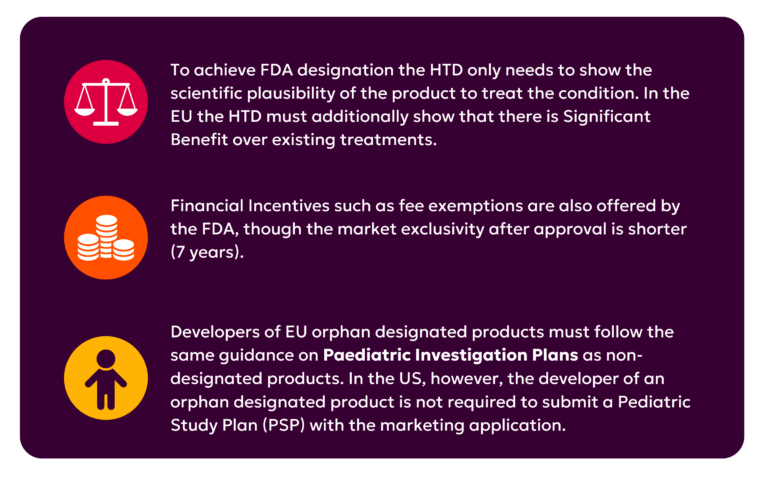
Prevalence Criteria: The threshold for the FDA is a fixed number (<200 000) compared to the percentage of current population in the EU. Effectively the EU has a lower threshold 5/10000 vs approx. 6/10000 (based on US population of 340M), though the gap is narrowing as the US population grows.
At Kintiga, we simplify the complex journey to achieve successful patient access across Europe. By uniting deep local market access expertise, a global perspective, and innovative strategies, we partner with health technology developers to deliver impactful, tailored solutions, maximising both market potential and patient outcomes for orphan drug therapies and beyond.
For further support with understanding how these regulations and framework could impact your market access strategy, please reach out to Kintiga via enquiries@kintiga.com.