Author: Ben Barron-Millar, Senior Consultant, Value Communication
Accelerating Access to Medicines
The UK is taking bold steps to accelerate access to innovative medicines for National Health Service (NHS) patients. Under the 10-Year Health Plan, National Institute for Health and Care Excellence (NICE) and the Medicines & Healthcare products Regulatory Agency (MHRA) are joining forces to streamline the approval and guidance process, cutting wait times by 3 to 6 months. This initiative is designed to make the UK a more attractive launch market for pharmaceutical companies while ensuring patients benefit from new treatments faster. A recent open letter from MHRA and NICE outlines the collaborative framework and calls on developers to engage early through UK PharmaScan.
A Unified Regulatory and HTA Pathway
NICE and MHRA are aligning their processes to enable simultaneous licensing and guidance publication. By registering early with both agencies, pharmaceutical companies can benefit from parallel assessments, reducing the time it takes for new medicines to reach patients. This approach supports the UK’s ambition to be a global leader in life sciences and healthcare innovation.
Streamlining Regulatory Processes
In their joint open letter, Julian Beach (MHRA) and Helen Knight (NICE) highlight the UK’s unique position as a single-payer healthcare system serving over 65 million people. They emphasise the importance of early engagement via UK PharmaScan, which allows both agencies to schedule evaluations efficiently. Medicines approved by MHRA and recommended by NICE must be made available by the NHS within 90 days, offering a transparent and predictable pathway to market (see Figure for MHRA and NICE Aligned Pathway below).
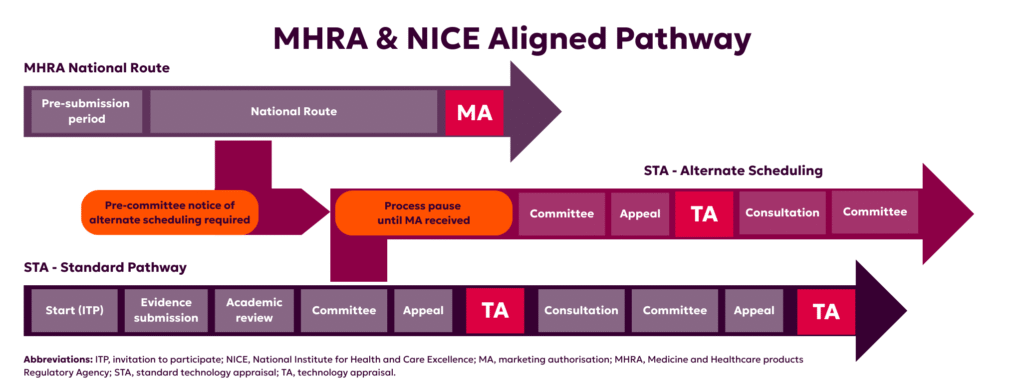
The letter also introduces a refreshed integrated scientific advice service and a new collaborative information-sharing model. Developers who opt in will benefit from priority committee scheduling and concurrent publication of NICE guidance with MHRA marketing authorisation in an effort to reducing delays.
For more complex topics, alternative scheduling may be adopted with NICE committee discussions beginning after marketing authorisation is granted. In this case, the aforementioned prioritisation benefits are lost as shown in Figure.
The plan is part of a broader government effort to reduce administrative burdens by 25% and support the life sciences sector. Companies must register products on UK PharmaScan at least three years before expected marketing authorisation to benefit from the new system. NICE has already made progress, reducing the time between licensing and guidance publication by 26%, with some guidance issued just 48 days post-licence.
It is worth noting that this initiative between NICE and the MHRA follows a similar pattern currently in place / being developed across the European Union. Joint clinical assessments (JCAs) are in progress in collaboration with the European Medicines Agency (EMA). Regional initiatives such as BeNeLuxA (Belgium, Netherlands, Luxembourg, Austria, Ireland) and the Nordic HTA collaboration (Sweden, Finland, etc.) further support horizontal cooperation among HTA bodies. These efforts aim to streamline evidence generation, reduce duplication, and accelerate access to innovative medicines by integrating EU-level assessments into national decision-making processes.
Industry Support and Future Outlook
Industry leaders have welcomed the NICE-MHRA joint initiative, citing its potential to improve patient outcomes and enhance the UK’s attractiveness for launching new medicines. The streamlined process is expected to foster innovation, reduce delays, and ensure that patients benefit from cutting-edge treatments sooner. Further information is expected in a forthcoming NICE-MHRA free webinar, on which Kintiga will provide key insights and learnings.
This initiative marks a transformative moment for UK healthcare. By aligning regulatory and HTA processes, NICE and MHRA are ensuring faster access to life-changing medicines for patients while supporting innovation in the pharmaceutical sector. If you are developing new treatments, now is the time to engage with UK PharmaScan and take advantage of this streamlined pathway. For support, reach out to Kintiga for insights on engaging with MHRA’s scientific advice service or NICE Advice and be part of shaping the future of healthcare in the UK.
References & Sources
- NICE (2025) Patients to receive medicines 3 to 6 months faster under 10-year Health Plan. URL: https://www.nice.org.uk/news/articles/patients-to-receive-medicines-3-6-months-faster-under-10-year-health-plan
- MHRA (2025) Open letter to the global pharmaceutical and biopharmaceutical industry. URL: https://content.govdelivery.com/accounts/UKMHRA/bulletins/3ec9183
- EMA (2025) Health technology assessment bodies. URL: https://www.ema.europa.eu/en/partners-networks/health-technology-assessment-bodies
- CIRS (2024) URL: https://cirsci.org/press/is-collaboration-between-and-across-regulatory-and-hta-agencies-the-answer-to-access-challenges/
Table of Abbreviations
- EMA European Medicines Agency
- HTA Health Technology Assessment
- JCA Joint clinical assessments
- MA Marketing authorisation
- MHRA Medicines & Healthcare products Regulatory Agency
- NHS National Health Service
- NICE National Institute for Health and Care Excellence
- STA Standard Technology Assessment